How many gels for an ultra? A table by finish time
Hours on course, times grams per hour, divided by the grams in your gel. The table does the sum from 5 to 30 hours.

By Jake Vita, Head of Marketing
- Published
- 11 min read
Key takeaways

Contents11 sections
- Key takeaways
- How many gels for an ultra, by time on course
- Gel sizes differ by brand, so count grams
- Why the table stops at 60 g an hour
- How to avoid eating 40 gels
- What aid stations take off the total
- How many gels to carry between aid stations
- How much spare to carry
- A worked example for a 10-hour race
- Flavour fatigue
- Sources
Multiply the hours you expect to be on the course by the grams of carbohydrate you plan to eat each hour, then divide by the grams of carbohydrate in one of your gels. A 10-hour race at 45 g an hour comes to 450 g, which is 15 gels of 30 g or 9 gels of 50 g.
That figure is the whole race counted in gels. You will carry less than that at any one time, because aid stations let you restock, and you will probably eat fewer gels than that, because chews, drink mix and ordinary food count towards the same total. The table gives the full number. The sections after it show how to bring it down to what goes in your pack. Every figure on this page is for healthy adults and is a starting point, not a prescription.
How many gels for an ultra, by time on course
Plan by time, because hills and rough ground can add hours to the same distance. Find your expected finish time in the left-hand column and read across to the hourly amount you have practised. In each cell the first figure is the total carbohydrate for the race. The figures in brackets are the number of 30 g gels, then the number of 50 g gels, that add up to it, rounded up to a whole gel.
| Time on course | At 30 g an hour | At 45 g an hour | At 60 g an hour |
|---|---|---|---|
| 5 hours | 150 g (5 or 3) | 225 g (8 or 5) | 300 g (10 or 6) |
| 6 hours | 180 g (6 or 4) | 270 g (9 or 6) | 360 g (12 or 8) |
| 8 hours | 240 g (8 or 5) | 360 g (12 or 8) | 480 g (16 or 10) |
| 10 hours | 300 g (10 or 6) | 450 g (15 or 9) | 600 g (20 or 12) |
| 12 hours | 360 g (12 or 8) | 540 g (18 or 11) | 720 g (24 or 15) |
| 15 hours | 450 g (15 or 9) | 675 g (23 or 14) | 900 g (30 or 18) |
| 18 hours | 540 g (18 or 11) | 810 g (27 or 17) | 1,080 g (36 or 22) |
| 20 hours | 600 g (20 or 12) | 900 g (30 or 18) | 1,200 g (40 or 24) |
| 24 hours | 720 g (24 or 15) | 1,080 g (36 or 22) | 1,440 g (48 or 29) |
| 30 hours | 900 g (30 or 18) | 1,350 g (45 or 27) | 1,800 g (60 or 36) |
The totals count every hour from the start. You will take your first fuel 30 to 45 minutes in, so the true figure is a little lower. Leave the difference in as slack.
If you don't know your finish time, use the slower of your guesses. Last year's results for your race show how long the back half of the field took, and that is a better guide than your road marathon pace.
Gel sizes differ by brand, so count grams
"Four gels" means nothing until you know which gel. Across brands, one gel holds anywhere from about 20 g to 50 g of carbohydrate, so the same count can be 80 g or 200 g. The carbohydrate figure per gel is in the nutrition table on the packet, in the per-serving column.
The sum works for any label.
- Hours on course multiplied by grams per hour gives your total grams.
- Total grams divided by the grams of carbohydrate in one gel gives the number of gels.
- Round up.
With a 22 g gel, the 10-hour race at 45 g an hour is 450 divided by 22, which is just over 20, so 21 gels. With a 40 g gel it is 12.
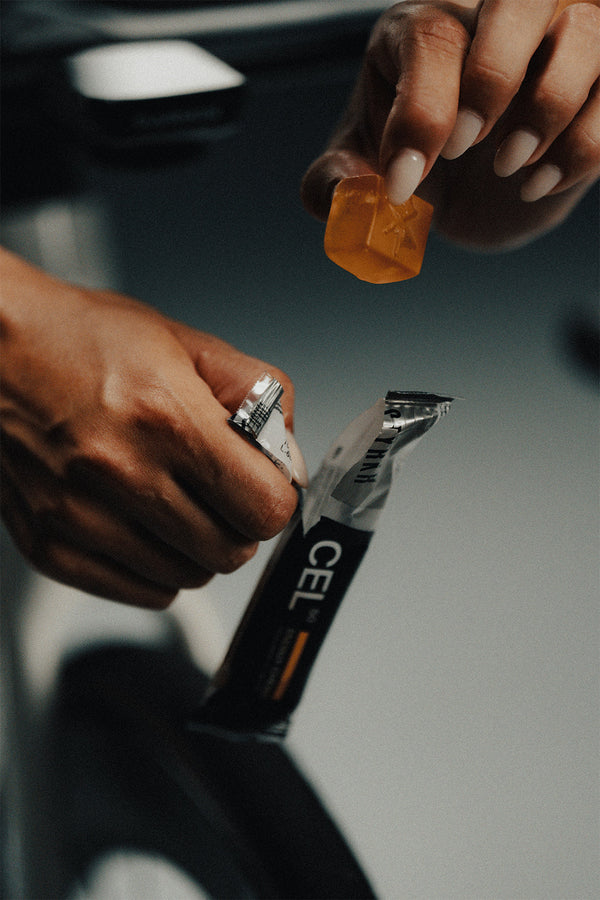
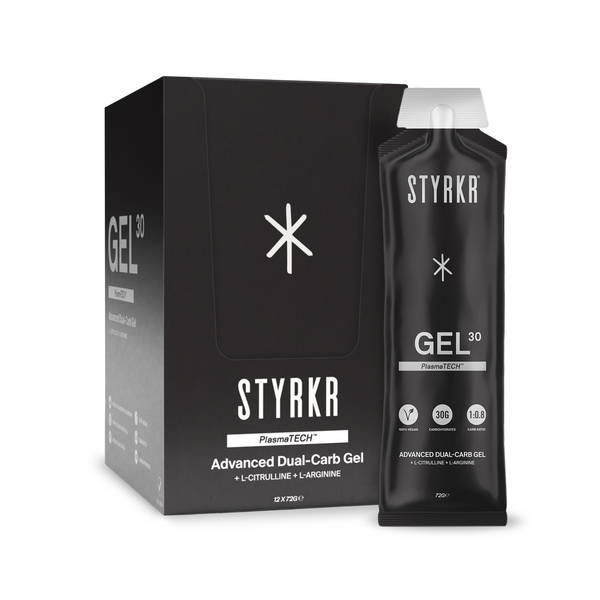
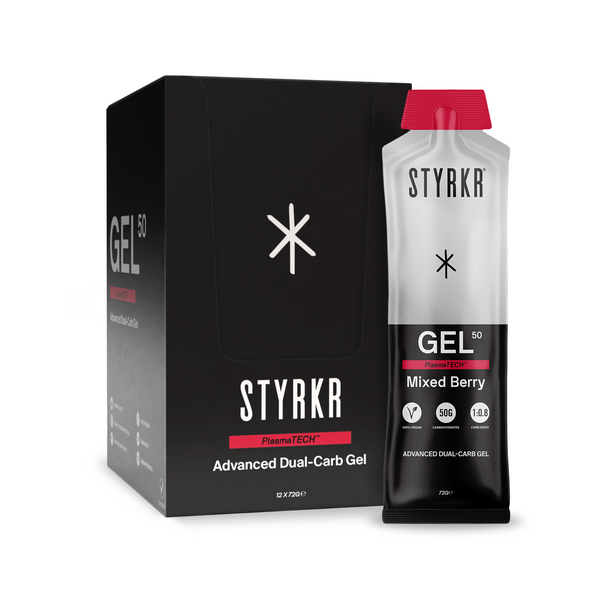
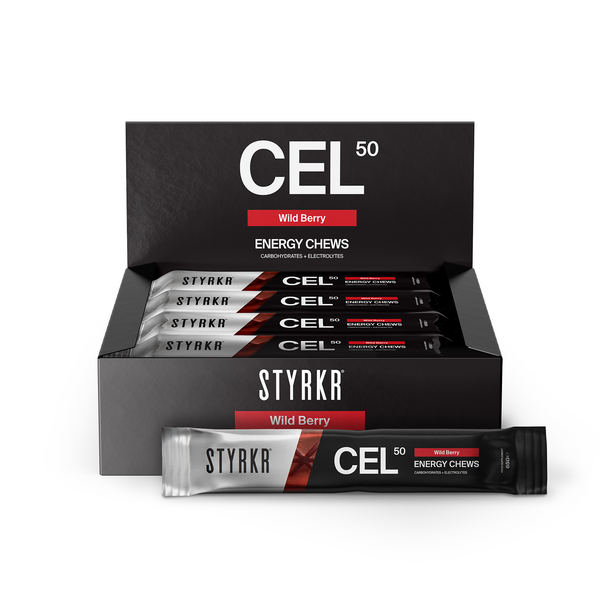
STYRKR's own gels are where the two columns in the table come from. A GEL30 has 30 g of carbohydrate and a GEL50 has 50 g. Chews go through the same sum. A pack of CEL50 is 50 g of carbohydrate, all of it glucose, in five chews of 10 g each, so one pack stands in for a 50 g gel and three chews for a 30 g gel.
The same sum tells you how often to eat. At 45 g an hour, a 30 g gel is due every 40 minutes. A 50 g gel every hour is 50 g an hour.

£24.99
Why the table stops at 60 g an hour
You have probably read that ultra runners should eat 90 g of carbohydrate an hour, and some say more. For a first ultra, plan at 30 to 60 g. Anything above 60 g only works with a mix of glucose (or maltodextrin) and fructose, because glucose alone tops out at about 60 g an hour, and it takes weeks of long runs to get the stomach used to it.
Experienced runners do go higher. Plenty of seasoned ultra runners race at 90 g an hour, and some gut-trained elites take up to 120 g. That is a level people work towards over seasons, not something to try on race day because a professional posted their plan. The table stops at 60 g because that is where a first-timer should be planning. If you are already eating more than that on long runs without trouble, the method is the same: multiply your hours by your own number.
Runners in real races eat less than the headline numbers. When researchers recorded everything five runners ate during a 120 km race, the average was about 44 g an hour. That is why there is a 45 g column in the table.
A higher target also means more to carry and more to get down. Over 20 hours, 90 g an hour is 1,800 g of carbohydrate, or 60 gels of 30 g. Pick the number you have held on long training runs and use that column. If your long runs go well at 60 g and you want more, raise it in training by about 10 g an hour at a time, and multiply your hours by the new number. Our ultra running nutrition guide covers how the hourly figure is chosen.
How to avoid eating 40 gels
Twenty hours at 60 g an hour is 40 gels of 30 g. The table shows it because that is what the sum gives. Don't read it as a shopping list. The total is grams of carbohydrate, and gels are one way to supply it.
In the 120 km study above, gels supplied about 40% of the carbohydrate the runners ate. The rest came from drinks and food. Five runners is a small sample, but a share of that size is a reasonable place to start, and it cuts the gel count by more than half.
Chews
Chews are counted exactly like gels, by the grams on the pack. Their advantage on a long day is that a pack comes apart, so you can take 10 or 20 g at a time on a climb where a whole gel feels like too much. We compare the two formats in energy gel vs energy chew.
Drink mix
Each bottle of carbohydrate drink you finish replaces gels. Read the grams per serving on the packet and count the bottle the same way. A bottle carrying 30 g is one 30 g gel you don't have to eat.
There is a limit to how much of the plan should sit in your bottles. Drink to thirst, and don't force fluid down to reach a carbohydrate number. On a cold day you may drink little, and if most of your fuel is in the bottle you will fall behind. Keep at least half of your hourly figure in things you eat, and treat the bottle as a top-up.
Ordinary food
Sandwiches, potatoes, crisps, fruit and cola all supply carbohydrate, and they bring salt and a change of taste that gels can't. They are harder to count, since a quarter of a sandwich has no label. Don't try. Give food a fixed share of each hour before the race, eat roughly that, and count the gels, chews and bottles precisely. No trial has shown that food beats gels over a long race, or the reverse, so the split is yours to choose. There is more on this in real food vs gels in ultra running.

What aid stations take off the total
Aid stations change two things, and it helps to keep them apart.
The first is how much you carry at once. If you can restock from a drop bag, a crew or the tables, you only need enough in your pack for the stretch to the next station. The number of gels you eat over the race stays the same.
The second is how many gels you eat at all. Food taken at the station replaces fuel from your pack. This is where the share for ordinary food comes from. If you plan on 45 g an hour and expect station food to cover about 15 g of it, your pack has to supply 30 g an hour, and you read the 30 g column.
How much you can lean on the tables depends on the race. Some UK ultras put gels and chews on every table. Others stock none and say so in the runner guide. Read yours before you count anything, and if you plan to use the brand on the tables, buy some and try it on long runs first. Our UK ultra and trail race calendar compares aid stations race by race. If the guide is vague, or the stations are far apart, pack for the full hourly figure and treat anything you eat at a table as extra.
How many gels to carry between aid stations
Turn the distance to the next station into time at your own pace, including the climbs. Then run the sum for that stretch alone.
A three-hour stretch at 30 g an hour from your pack is 90 g. That is three 30 g gels, or one 50 g gel and four 10 g chews. A five-hour stretch overnight at the same rate is 150 g. Write the number of grams for each leg on a strip of tape or on your drop bag labels, so that restocking at a station takes no thought.
If the race has no drop bags and no crew, and you won't use the gels on the tables, everything in the table row goes in your pack at the start. For a long race that is a lot of weight, and a good reason to let station food carry a larger share.
How much spare to carry
Carry one hour of fuel beyond the plan, and keep it somewhere separate. People slow down, drop gels on descents, and reach stations that have run short. An extra hour at your planned rate covers most of that, and for most runners it is one or two gels.
If you eat the spare, replace it at the next station.
Some races also require an emergency food reserve in the mandatory kit, to be carried unused to the finish. That is a separate item from your spare hour and from your race fuel. Our ultra kit list covers what counts.

A worked example for a 10-hour race
A runner expects to finish a 50-mile race in about 10 hours and has practised 45 g an hour. The runner guide lists sandwiches, fruit, crisps and cola at every aid station, and there is a drop bag at halfway.
- Total for the race is 10 multiplied by 45, which is 450 g.
- Station food and cola are given 15 g an hour, which is 150 g over the race and is not counted item by item.
- The pack supplies the other 30 g an hour, 300 g in all.
- Using STYRKR products, that could be five GEL30 (150 g) and three packs of CEL50 (150 g).
- The spare hour is one more GEL50, kept apart.
Roughly half goes in the pack at the start and the rest in the drop bag, with the spare carried throughout. That is eight items to eat and one spare, where the table row for 45 g says 15 gels.
Check the sodium as well, because this plan is light on it. The gels contain none. Each pack of CEL50 has 267 mg, so three packs give about 800 mg over the whole race, or roughly 80 mg an hour. The usual starting range in efforts over two hours is 300 to 600 mg an hour. The rest has to come from the salty food at the stations or from an electrolyte drink in the bottles, and the plan should say which. Our article on salt and electrolytes in ultras goes through the options.
What that many gels weigh
Both GEL30 and GEL50 hold 72 g of gel per sachet. The wrapper adds a little, so weigh one on kitchen scales if you want the exact figure for your pack.
The five GEL30 in the example are 360 g of gel. If the runner carried the full 450 g as gels and nothing else, it would be 15 GEL30 at 1,080 g, or nine GEL50 at 648 g. Because the two sachets hold the same weight of gel, the 50 g size carries the same carbohydrate for less weight. The cost is a larger dose each time you open one.
For any other gel, multiply the net weight printed on the sachet by the number you are carrying.
Flavour fatigue
A count that works on paper can fail because you can't face gel number nine. Sweet things get harder to eat as the hours pass, and fuel that stays in the pack does nothing for you.
Split the count across at least two flavours and two textures, and make sure something in each leg isn't sweet. Put the foods you like most in the second half of the race, when you will need the encouragement. If any of your gels contain caffeine, add up the milligrams as well as the grams. Most adults should stay under 400 mg a day.
Then test the plan. On your longest training runs, eat the exact items, in the amounts and at the intervals you have written down. If you are leaving gels uneaten by the end, change the mix before race day. Our guide to gut training explains how to build up.
Fuel for this guide
-
GEL30 Dual-Carb Energy Gel
£24.99
-
GEL50 Dual-Carb Energy Gel Mixed Berry
£29.99
-
CEL50 Berry
£49.99
Sources
- A Step Towards Personalized Sports Nutrition: Carbohydrate Intake During Exercise (Jeukendrup, 2014). Sports Medicine, via PubMed Central. https://pmc.ncbi.nlm.nih.gov/articles/PMC4008807/
- International Society of Sports Nutrition Position Stand: nutritional considerations for single-stage ultra-marathon training and racing (Tiller et al, 2019). Journal of the International Society of Sports Nutrition, via PubMed Central. https://pmc.ncbi.nlm.nih.gov/articles/PMC6839090/
- Real-Time Observations of Food and Fluid Timing During a 120 km Ultramarathon (Wardenaar et al, 2018). Frontiers in Nutrition, via PubMed Central. https://pmc.ncbi.nlm.nih.gov/articles/PMC5946582/
- Nutrition and Supplement Update for the Endurance Athlete: Review and Recommendations (Vitale and Getzin, 2019), for the 300 to 600 mg an hour sodium starting range. Nutrients, via PubMed Central. https://pmc.ncbi.nlm.nih.gov/articles/PMC6628334/